Do you have doubts about lighting in the kitchen? Do you want to take advantage of natural light in this area of the house? Would you like to have the best advice to light up a kitchen? If you ask yourself these questions, you are reading the best article. In this post,we will help you to give more life to your kitchen.
Lighting in the kitchen: the keys to doing it correctly
the most relevant key, among others, are :
Take advantage of natural light in the kitchen
The perfect lighting in the kitchen is always the result of the combination of artificial light with natural light. Therefore, if the kitchen has natural light it should be used, planning the distribution so that it does not cover or cause difficulty to the circulation of light.
Definition of the uses of lighting in the kitchen
When you think about the lighting of this place in the house, you should consider if you only use it for cooking, if you eat there it or if it is a place of passage. You should also think about the little ones, since they are in most cases the ones who demand the most improvements in lighting. The general light should always exist but also occasionally a natural entrance to avoid leaving dark areas.
Energy saving
And the best option to improve the environment and save on the bill is to have LED lights. Its consumption is low, reaching up to 95% less than traditional bulbs and being the highest useful life up to 50,000 hours, ten times more than an incandescent light. At present, different types of ferrules are being commercialized today.
General light planning
In this area of the house is vital to have constant and intermittent light, hence ,the best idea is the distribution of lights, better if they are LED, for the entire kitchen. When choosing them, it must be taken into account that they have a focal aperture of at least 60 º, since they have a greater expansion of the lights.
Safe work areas
It is vital that in the area where the food is handled tjhat there is an ideal point lighting. It is best to place the lights under high modules.
The choice of LEDs, quality
When it comes to cooking, seeing the color of the different foods is important and in it has to see the light. Choose a high LED, which indicates quality, since it will help you to perceive colors better.
Multiply the quality
The white color, the lacquers, the crystals and the steel are materials and finishes that come to reflect the light and will help you to make the kitchen clear.
Comfort first of all
With the choice of all types of lamps, it is always advisable to value that everything is practical. The lamps with metal or glass screens are easy to clean, being the best option to fight grease and odors generated in the kitchen.
The tips for lighting a kitchen
When deciding how to illuminate this space, you should look for both originality and functionality. The lighting must be attractive, oriented to different areas to perform daily tasks. What ideas or advice can we offer for the lighting of this area?
Illuminate from the ceiling
In this case, it will be what provides the general or ambient light. The most common in terms of color temperature is to have cold tones that improve visibility and concentration, always thinking about something that is useful to avoid accidents. However, nothing prevents you from opting for warmer lights if you want to have a more welcoming atmosphere.
Illuminate from the countertops
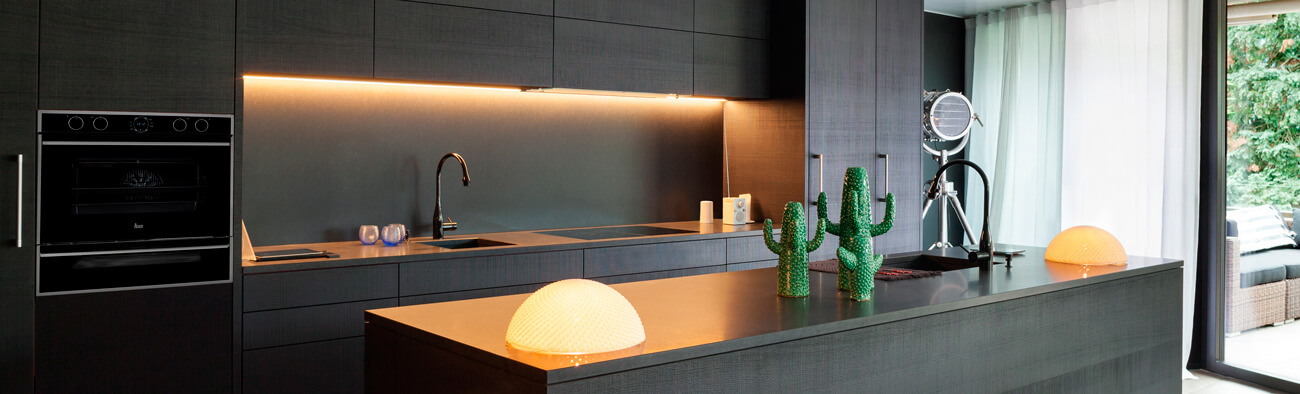
This type of lighting is used in work areas that need more light. LEDs are an option for these points, since they do not heat up like incandescent bulbs. The facility to hide the cables is their strong point so that they are hidden from view and can illuminate the surface.
LED lights are a good choice for lighting because, unlike halogens, they stay cool and there is no danger of feeling the heat of bulbs or spotlights while working under them.
Furniture lighting
The lighting of the furniture can be useful and very functional. The LED lighting creates an important visual effect in the floating shelves, for example, adding eye-catching to the whole area. In addition, the thin thickness of the strips, thanks to the type of LED that integrates it, makes it an ideal complement to the furniture that highlights it.
Lighting in the kitchen should combine artificial light with natural light. In addition, to illuminate our Teka appliances, it is vital to follow a series of tips to light up a kitchen in the right way.
How CasinosWelcomeBonus Explains Casino Welcome Bonus Wagering Requirements in Canada
For Canadian players navigating the online casino landscape, welcome bonuses represent one of the most visible and frequently misunderstood aspects of the gambling experience. On the surface, a welcome bonus appears straightforward: a casino matches a portion of your deposit, giving you additional funds to play with. In practice, however, the conditions attached to these bonuses — particularly wagering requirements — determine whether a bonus has any realistic value at all. Understanding how these requirements work, how they are structured under Canadian market conditions, and how to evaluate them critically is essential knowledge for any player who wants to make informed decisions rather than simply chasing headline figures.
What Wagering Requirements Actually Mean and How They Are Calculated
A wagering requirement, sometimes called a playthrough requirement, specifies how many times a player must bet the bonus amount — or in some cases the combined total of the bonus and deposit — before any winnings derived from that bonus can be withdrawn. The requirement is expressed as a multiplier, such as 30x, 40x, or 50x. If a casino offers a $200 bonus with a 40x wagering requirement, the player must place a total of $8,000 in qualifying bets before the bonus converts into withdrawable cash. This figure can be significantly higher when the requirement applies to the sum of both the deposit and the bonus rather than the bonus alone, a distinction that is frequently buried in the terms and conditions.
The calculation becomes further complicated by game contribution rates. Casinos do not count all wagers equally toward the wagering requirement. Slot games typically contribute 100 percent, meaning every dollar bet on slots counts fully toward clearing the requirement. Table games such as blackjack, roulette, and baccarat often contribute between zero and twenty percent, and some casinos exclude them entirely from bonus play. Video poker may contribute between zero and fifty percent depending on the operator. This weighting system exists because games with lower house edges — particularly blackjack played with basic strategy, which can reduce the house edge to below 0.5 percent — would make it mathematically feasible for skilled players to clear wagering requirements profitably. By restricting contributions from these games, casinos protect their margins while still offering bonuses as a marketing tool.
Time limits add another layer of complexity. Most welcome bonuses in the Canadian market carry an expiry window of between seven and thirty days, within which the entire wagering requirement must be satisfied. If a player fails to meet the requirement within this period, both the bonus funds and any winnings generated from them are typically forfeited. Some operators impose even shorter windows of three to five days, which can make it practically impossible to clear a large bonus without placing bets at a pace that encourages reckless play. The interplay between the multiplier, the game contribution rates, and the time limit together determine the true difficulty of a bonus, and all three must be considered together rather than in isolation.
The Canadian Regulatory Context and How It Shapes Bonus Transparency
Canada’s approach to online gambling regulation has historically been fragmented, with authority divided among provincial jurisdictions rather than governed by a single federal framework. For many years, the dominant legal operators in Canada were the provincial lottery corporations — entities such as the British Columbia Lottery Corporation, the Alcohol and Gaming Commission of Ontario’s iGaming Ontario framework, and Loto-Québec — each operating under different standards and with varying degrees of transparency regarding bonus terms.
The most significant regulatory development in recent years was the launch of Ontario’s regulated iGaming market in April 2022. Under this framework, private operators must be registered with iGaming Ontario and are required to adhere to standards set by the Alcohol and Gaming Commission of Ontario. One of the practical effects of this regulation has been increased pressure on operators to present bonus terms clearly and accessibly. The AGCO’s Registrar’s Standards for Internet Gaming, which came into force alongside the market opening, include provisions around fair and transparent communication with players, which indirectly affects how wagering requirements must be disclosed.
Outside Ontario, Canadian players accessing offshore-licensed casinos — those operating under licenses from jurisdictions such as Malta, Gibraltar, Curaçao, or the Isle of Man — encounter a more variable landscape. These operators are not subject to Canadian provincial oversight, and their bonus terms can vary dramatically in both structure and transparency. The Malta Gaming Authority, which regulates a significant proportion of the online casinos accessible to Canadian players, has introduced its own player protection directives over the years, including requirements around clear disclosure of bonus conditions. However, enforcement and the practical presentation of this information differ considerably between operators even within the same licensing jurisdiction.
Resources that specialize in analyzing these conditions for Canadian players have become increasingly important in this environment. The CasinosWelcomeBonus website, for instance, provides structured breakdowns of wagering requirements across operators accessible to Canadian players, helping users compare the actual conditions rather than the headline bonus figures that dominate advertising. This kind of comparative analysis is particularly valuable given that the same nominal bonus — say, a 100 percent match up to $500 — can carry a 25x requirement at one casino and a 60x requirement at another, making the two offers categorically different in terms of realistic value.
How to Evaluate the Real Value of a Welcome Bonus in Practice
Calculating the theoretical value of a welcome bonus requires understanding the concept of expected value as applied to casino gaming. The expected value of a bonus is determined by the size of the bonus, the house edge of the games used to clear it, and the wagering requirement. A simplified formula used by experienced players is: Bonus Value = Bonus Amount minus (Wagering Requirement multiplied by House Edge). For a $200 bonus with a 40x requirement cleared entirely through slots with a 4 percent house edge, the calculation would be $200 minus ($8,000 multiplied by 0.04), which equals $200 minus $320, producing a negative expected value of minus $120. In this scenario, the bonus is statistically likely to cost the player money rather than benefit them, despite appearing generous on the surface.
This calculation changes significantly based on which games are used. If the same bonus could be cleared through blackjack with a 0.5 percent house edge — which most casinos prevent through restricted contribution rates — the calculation would be $200 minus ($8,000 multiplied by 0.005), equaling $200 minus $40, for a positive expected value of $160. This is precisely why casinos restrict table game contributions, and it illustrates why the contribution rate table in the terms and conditions is one of the most consequential pieces of information a player can examine before claiming a bonus.
Maximum bet restrictions during bonus play are another critical variable. Most casinos impose a cap on the size of individual bets while a bonus is active, typically ranging from $5 to $10 per spin or hand. Exceeding this limit — even accidentally — is grounds for voiding the bonus and any associated winnings under the terms of most operators. These restrictions are designed to prevent players from attempting to clear the wagering requirement as quickly as possible through high-stakes bets, and violating them, even unintentionally, can result in the loss of significant winnings. Players who are accustomed to playing at higher stakes than the cap allows may find that bonus play requires a fundamental adjustment to their approach.
Sticky bonuses, also known as non-cashable bonuses, represent a distinct category that requires separate consideration. With a sticky bonus, the bonus amount itself can never be withdrawn — only the winnings generated from it can be cashed out after the wagering requirement is met. This structure is actually more favorable to players in certain scenarios, because it allows the casino to offer a higher nominal bonus while protecting itself from the full liability of a cashable bonus. A $500 sticky bonus with a 20x requirement may offer better expected value than a $200 cashable bonus with a 40x requirement, depending on the games available and the player’s risk tolerance. Recognizing the distinction between sticky and cashable bonuses is therefore a fundamental part of evaluating any welcome offer.
Common Misconceptions and Practical Guidance for Canadian Players
One of the most persistent misconceptions among players new to online casinos is that a larger bonus is inherently more valuable than a smaller one. The headline figure — a $1,000 welcome bonus, for example — is a marketing number, not a measure of value. A $1,000 bonus with a 60x wagering requirement represents $60,000 in required bets, which at a 4 percent house edge on slots produces an expected loss of $2,400 from the wagering process alone. By contrast, a $200 bonus with a 20x requirement represents $4,000 in required bets, producing an expected loss of $160. The smaller bonus is dramatically more valuable in expected value terms, and yet it is the larger figure that appears in advertising and captures player attention.
Another widespread misunderstanding concerns the relationship between bonus funds and real money funds within a player’s account. Most casinos operate a system in which real money funds are used before bonus funds when placing bets, or in some cases the reverse. The order in which these funds are depleted affects the player’s ability to withdraw real money winnings before the bonus is cleared. If real money is used first and the player wins, those winnings may be locked behind the wagering requirement attached to the bonus. Understanding the fund priority system at a specific casino requires reading the full terms carefully, and this information is rarely highlighted in the promotional material for a bonus.
The concept of bonus abuse, as defined by online casinos, is also frequently misunderstood by players who believe they are engaging in legitimate strategic play. Casinos reserve the right to void bonuses and withhold winnings if they determine that a player has engaged in what they classify as bonus abuse, a term that is defined broadly and inconsistently across operators. Activities that may trigger this classification include opening multiple accounts, using software to optimize play, coordinating with other players to exploit bonus conditions, or even simply playing in a mathematically optimal way that the casino deems contrary to the spirit of the promotion. While legitimate players are unlikely to be targeted by these provisions, understanding that they exist and that they give casinos significant discretionary power over bonus outcomes is important context.
For players in Ontario specifically, the regulated market provides some additional protections that are not available to those playing on offshore platforms. Registered operators under the iGaming Ontario framework are subject to dispute resolution processes and regulatory oversight that give players a formal avenue for complaints, including complaints related to bonus terms and their application. Players on offshore platforms have no equivalent recourse through Canadian regulatory bodies, though some licensing jurisdictions such as the Malta Gaming Authority operate their own player complaint mechanisms. The practical effectiveness of these mechanisms varies, but their existence represents a meaningful difference between regulated and unregulated market participation.
Responsible gambling considerations intersect with wagering requirements in ways that are not always acknowledged in discussions of bonus value. The pressure to clear a wagering requirement within a time limit can create conditions that encourage extended play sessions and bets at higher frequencies than a player might otherwise choose. Recognizing this dynamic is part of approaching casino bonuses with a realistic understanding of their design. Bonuses are structured to generate play volume, and the wagering requirement is the mechanism through which this is achieved. Players who approach bonuses with a clear budget, a defined time limit that they set independently of the casino’s expiry window, and a willingness to forfeit uncompleted bonuses rather than chase them are better positioned to use bonuses as tools rather than be used by them.
Understanding casino welcome bonus wagering requirements in Canada requires moving beyond the promotional surface of these offers and engaging with the underlying mathematics, the regulatory context, and the specific contractual terms that govern each bonus. The Canadian market, particularly following Ontario’s 2022 regulatory reforms, has become more structured in some respects, but significant variability remains across the operators accessible to Canadian players. Evaluating a bonus on its actual expected value, its game contribution structure, its time constraints, and its compatibility with your typical play style produces a far more accurate picture than any headline figure. Players who develop this evaluative framework are equipped to identify offers that genuinely add value to their experience and to decline those that appear generous while delivering the opposite.