Knowing how to choose a range hood is essential, as this appliance is not only useful, but also decorative. Therefore, in Teka, we have decided to give you some tips, so that no detail is overlooked.
The functions of the extractor hood
Extractor hoods are appliances focused on the cleanliness and hygiene of your kitchen. In addition to smoke and odors, they absorb steam and grease.
Using the hood regularly will help you keep the kitchen clean, and to avoid that the whole house smells for days to those selicious mussels you know how to prepare.
Therefore, it is important that you pay attention to the technical characteristics of your hood. The most important specifications you should consider to know how to choose an extract hood are the following.
Technical specifications
- Size. If you want your hood to be effective, it must have at least the dimensions of your stove or ceramic hob. However, whenever you can install a wider hood, it is best to do so. Keep in mind that the hood absorbs more effectively what is underneath, so a large hood will help the grease and odors do not spread around your house.
- Power. The extraction capacity of the kitchen hoods is calculated in cubic meters / hour. To calculate how many you need to empty your kitchen, multiply the width, length and height of your kitchen to find out its volume. The ideal power is that which allows you to empty between twelve and fifteen times that amount per hour. Therefore, you will have to multiply the volume of your kitchen by this figure.
- Consumption. The first problem of increasing the power of your hood is that you will also increase its consumption. However, hoods are appliances that do not need much energy to work, so you should not worry too much about this detail.
- Noise. Noise is the second problem derived from increasing the power of your hood, and this one is more problematic. Bells produce noise levels that can reach 80 dB. However, since the decibel is a logarithmic unit, we do not recommend that you exceed 60 dB if you do not want to end up cooking.
-
Finishes. Your extractor hood can include lights, which will help you cook. In addition, they can be manufactured in different materials, but if you use metallic finishes it will cost less to clean it. Keep in mind that this appliance is designed to absorb grease, so that all ease of cleaning is low.
Extraction hoods and recirculation hoods
Currently, the kitchen hoods use two smoke and odor treatment systems.
- The extraction hoods absorb the fat, vapor and smoke in suspension and extract it from the building through the circulation pipes. They are very efficient and their grids are easy to disassemble and clean.
- The recirculation hoods use carbon filters to purify the air, returning it clean to the room. Although they need to replace the filter periodically, they do not need to install tubes, so it is a frequent choice for island bells.
Types of kitchen hood
You must bear in mind that the size and position of your hood make it a very visible appliance. Therefore, the normal thing is that you want your kitchen hood to be as beautiful or as discreet as possible.
If so, you are in luck, since there are numerous models on the market that will allow you to select the hood that best suits your style.
Built-in hoods
They are placed inside the kitchen furniture to disguise the motors. They are the most classic option and a great success if you have design furniture in your kitchen that gives it a homogeneous appearance.
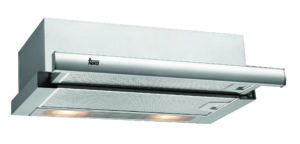
Extra-flat hoods
They consist of a pair of superposed trays, like a drawer. When you take out the mobile tray, the hood starts to work. They are the most discreet, as well as relatively inexpensive.
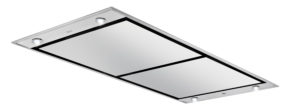
Decorative hoods
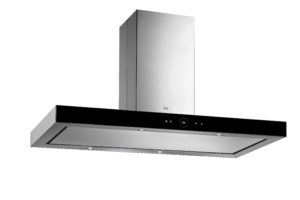
They are design hoods, which present various shapes and colors. Some are broad, flat surfaces, while others have rounded or, more commonly, pyramidal shapes. They usually have finished lacquers to provide a touch of color or metallic, in stainless steel.
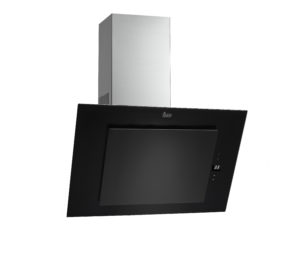
Island hoods
These hoods tend to be the most powerful, as they are designed to be installed in the center of the kitchen. That’s why they tend to be very large, so they have very careful and elaborate designs.
Conclusion
The choice of your kitchen hood is very particular and will depend on your needs and the style of your home. However, we hope that our indications have given you useful information to know how to choose your bell. The last relevant element is the price, so we invite you to check out our catalog, because in Teka we have the best option for you.
Why Low Deposit Gambling Is Growing in New Zealand According to 5DollarDepositCasinos
New Zealand’s online gambling market has undergone a significant shift over the past several years, and one of the clearest indicators of that shift is the rapid growth of low deposit gambling options — particularly those accepting minimum deposits of five dollars or less. What was once considered a niche offering aimed at cautious newcomers has evolved into a mainstream segment of the market, attracting a wide demographic of players who prioritise financial flexibility, responsible spending, and accessibility over the high-roller experience. Understanding why this trend is accelerating requires looking at regulatory context, consumer behaviour, banking infrastructure, and the broader digital economy in which New Zealand gamblers are operating today.
The Regulatory Landscape Shaping Player Behaviour
New Zealand’s gambling legislation has historically been among the more restrictive in the Asia-Pacific region. The Gambling Act 2003 remains the primary piece of domestic legislation governing gambling activities, and it explicitly prohibits New Zealand-based operators from offering online casino services to residents. This legal structure has created a unique dynamic: New Zealanders are not prohibited from gambling at offshore-licensed sites, but there is no domestic licensing framework for online casinos. The result is a market dominated by operators licensed in jurisdictions such as Malta, Gibraltar, Curaçao, and the Isle of Man — all of which are free to set their own minimum deposit thresholds.
Because offshore operators are competing for New Zealand players without the protection of a domestic regulatory monopoly, they have strong commercial incentives to lower barriers to entry. A five-dollar minimum deposit is one of the most effective tools for doing exactly that. It reduces the perceived financial risk for a first-time depositor, particularly one who may be unfamiliar with a specific platform or uncertain about how a particular payment method performs in New Zealand. From a regulatory standpoint, there is nothing preventing these operators from setting low thresholds, and the competitive pressure among dozens of licensed offshore sites has driven minimums steadily downward over the past decade.
The New Zealand government has periodically reviewed its gambling laws, and there has been ongoing discussion about whether to introduce a domestic licensing regime that would bring online casino revenue under local tax jurisdiction and subject operators to New Zealand-specific consumer protections. As of the mid-2020s, no such framework has been enacted, which means the offshore-dominated status quo continues — and with it, the competitive dynamics that favour low deposit offerings. Consumer advocacy groups and the Department of Internal Affairs have both noted the challenge of regulating a market where the primary operators are beyond the direct reach of New Zealand law, and this regulatory gap has, paradoxically, created conditions in which player-friendly features like low deposits have flourished.
Banking Infrastructure and the Rise of Instant Payment Methods
One of the structural reasons low deposit gambling has grown so significantly in New Zealand is the evolution of the country’s banking and payment infrastructure. Historically, New Zealand players faced friction when depositing at online casinos — bank transfers were slow, credit card transactions were sometimes declined by issuing banks applying their own internal policies around gambling merchants, and international wire transfers carried fees that made small deposits economically impractical. Depositing five dollars via a bank transfer that costs two dollars in fees and takes three business days to clear is not a proposition many players would accept.
The situation changed substantially with the widespread adoption of e-wallet services and, more recently, instant payment platforms. Services like POLi, which allows direct bank-to-bank transfers without requiring a card, became popular among New Zealand online gamblers because they circumvented many of the friction points associated with traditional card payments. POLi transactions are processed in real time and carry no additional fees for the end user in most configurations, making five-dollar deposits genuinely practical rather than theoretically possible. Similarly, the growth of Visa and Mastercard prepaid options — which can be loaded with small amounts and used at gambling sites without exposing a primary bank account — has made micro-deposits more accessible to a broader population.
Cryptocurrency has also played a role, particularly among more technically sophisticated segments of the New Zealand gambling population. Bitcoin, Ethereum, and stablecoins like USDT allow for borderless, near-instant transactions with low or negligible fees, and several offshore operators have specifically targeted New Zealand players with crypto-compatible low deposit structures. While crypto adoption in New Zealand gambling remains smaller than e-wallet and card usage in absolute terms, it has contributed to normalising the idea that a meaningful gambling session can begin with a very small financial commitment. When our experts found that the most frequently visited low deposit casino pages among New Zealand users consistently featured multiple payment method options — rather than a single dominant channel — it reinforced the conclusion that payment flexibility and low minimums are deeply intertwined drivers of this market segment’s growth.
The Reserve Bank of New Zealand’s ongoing work on open banking standards is also relevant here. As open banking frameworks mature, third-party payment initiators will have more direct access to bank account infrastructure, potentially enabling even faster and cheaper small-value transactions. This is not a development unique to gambling, but gambling platforms are well-positioned to benefit from it because the friction associated with depositing is one of the primary reasons players abandon sign-up flows before completing a first deposit. Reducing that friction at the five-dollar level could further accelerate the trend already underway.
Consumer Psychology and the Responsible Gambling Dimension
The growth of low deposit gambling in New Zealand is not solely a story about infrastructure and regulation — it is equally a story about how players think about risk, money, and entertainment value. Behavioural economics research conducted in gambling contexts consistently shows that the size of an initial deposit functions as a psychological anchor for a player’s session budget. Players who deposit twenty dollars tend to lose more in absolute terms before stopping than players who deposit five dollars, not because the games are different, but because the initial commitment creates a reference point against which losses and wins are measured.
For a segment of the New Zealand gambling population that is genuinely motivated by responsible gambling principles — rather than simply using responsible gambling language as a marketing frame — the five-dollar deposit represents a meaningful constraint. It is not possible to lose more than five dollars in a session if you have only deposited five dollars, and no bonus or promotional mechanic can change that mathematical ceiling. This is a qualitatively different kind of player protection from the self-exclusion schemes and deposit limit tools that regulators typically focus on, because it operates at the point of entry rather than requiring the player to proactively manage their own behaviour after already committing funds.
5DollarDepositCasinos, a New Zealand-focused review and comparison platform, has documented this pattern extensively in its analysis of player behaviour at low minimum deposit sites. The platform’s research suggests that a meaningful proportion of New Zealand players who specifically seek out five-dollar deposit casinos are not doing so because they cannot afford to deposit more — they are doing so because they want to maintain a strict entertainment budget and find that the low deposit threshold functions as a natural session limit. This is a nuanced finding that challenges the assumption that low deposit gambling is primarily a product for lower-income demographics. In reality, it appears to attract a broad income range, with the common thread being a preference for controlled, defined spending rather than open-ended financial commitment.
There is also a trust dimension to consider. New Zealand players interacting with offshore operators for the first time are making a decision to send money to a company that is not subject to New Zealand consumer protection law in any direct sense. A five-dollar deposit is a low-cost way to test whether a platform processes deposits correctly, whether withdrawals are honoured in a timely fashion, and whether the customer support function is responsive. It is, in effect, a due diligence mechanism. Players who have a positive experience at the five-dollar level are more likely to increase their deposit amounts over time, which means low deposit thresholds serve the long-term commercial interests of operators as well as the short-term risk management interests of players.
Market Competition and the Operator Perspective
From the supply side of the market, the proliferation of low deposit options in New Zealand reflects intense competition among offshore operators for a player base that is relatively small by global standards but disproportionately valuable in terms of per-capita spending. New Zealand has a population of approximately five million people, and internet penetration and disposable income levels are both high relative to regional averages. This makes New Zealand players attractive acquisition targets even though the absolute numbers are modest compared to markets like the United Kingdom, Germany, or Australia.
Operator acquisition costs in mature online gambling markets are substantial. The cost of acquiring a depositing player through affiliate marketing, paid search, and other channels has increased significantly since the early 2010s, driven by rising competition and tightening advertising restrictions in major markets. In this environment, conversion rate optimisation — getting a higher percentage of site visitors to complete a first deposit — is a critical commercial priority. Lowering the minimum deposit threshold is one of the most direct levers operators can pull to improve conversion rates, because it reduces the financial barrier at the precise moment when a prospective player is deciding whether to commit.
The competitive dynamics also play out in bonus structures. A five-dollar deposit is only attractive if the associated welcome bonus is calibrated to that deposit size. Early iterations of low deposit bonuses in the New Zealand market were often poorly designed — a 100% match bonus on a five-dollar deposit produces five dollars in bonus funds, which at standard wagering requirements of 30x to 40x means the player needs to wager between 150 and 200 dollars before withdrawing any bonus-derived winnings. That structure is not particularly compelling. More recent bonus designs at low deposit casinos have moved toward free spins packages, no-wagering bonuses, or cashback offers that deliver perceived value even at the five-dollar entry point. 5DollarDepositCasinos has tracked this evolution in bonus design and noted that operators who have refined their low deposit bonus structures have seen measurably better player retention metrics in the New Zealand market specifically.
Game providers have also adapted to the low deposit segment. The development of slot games with minimum bet sizes of one cent or two cents — compared to the twenty-cent or fifty-cent minimums common in earlier generations of online slots — means that a five-dollar bankroll can sustain a meaningful number of spins. A player with five dollars and a two-cent minimum bet has 250 spins available before their bankroll is exhausted, assuming no wins. That is a session of genuine duration, particularly if the player is playing at a moderate pace. This compatibility between low deposit amounts and low minimum bet sizes is not coincidental — it reflects deliberate product design decisions by software developers who recognise that the low deposit segment represents a large and growing portion of the global online casino market.
The growth of mobile gambling has further reinforced these trends. New Zealand has high smartphone penetration, and a significant proportion of online gambling activity occurs on mobile devices. Mobile sessions tend to be shorter and more frequent than desktop sessions, which aligns naturally with the low deposit model. A player who deposits five dollars during a commute or lunch break, plays for twenty minutes, and either wins a small amount or accepts a small loss, is engaging with gambling as a genuinely casual entertainment activity. The low deposit threshold makes this kind of casual, contained engagement financially viable in a way that a fifty-dollar minimum deposit does not.
The trajectory of low deposit gambling in New Zealand shows no signs of reversing. The combination of a regulatory environment that preserves offshore operator competition, a payment infrastructure that makes small transactions practical and immediate, a consumer base that increasingly values financial control and defined entertainment budgets, and operators with strong commercial incentives to lower entry barriers has created a self-reinforcing dynamic. As banking technology continues to evolve and open banking frameworks develop further, the practical minimum for a meaningful online gambling deposit may fall even below five dollars in some contexts. The five-dollar threshold that currently defines this market segment is less a permanent floor than a reflection of where the technology, regulation, and consumer behaviour happen to intersect at this particular moment in New Zealand’s online gambling history. Players, operators, and policymakers alike would benefit from understanding the structural forces driving this growth, rather than treating low deposit gambling as a superficial marketing trend or a temporary feature of an immature market.